What a 2 Roll Mill Actually Does
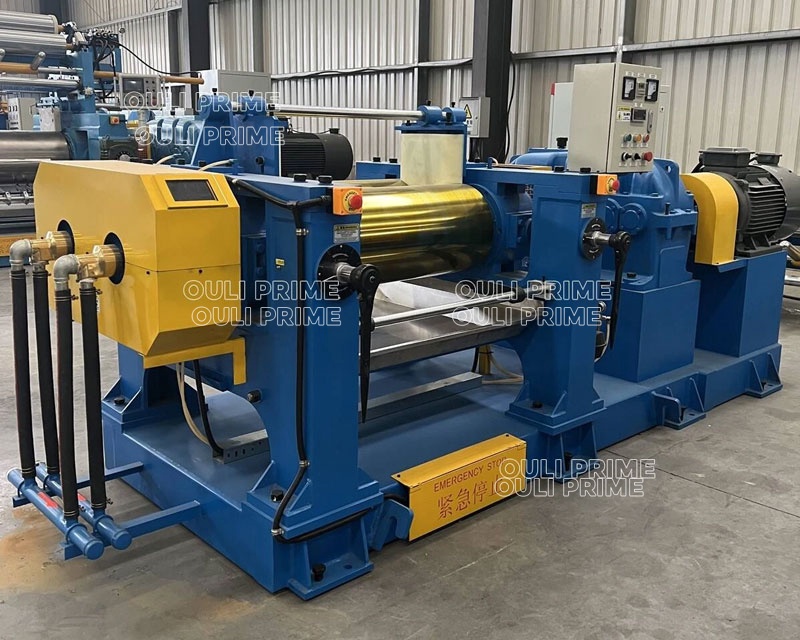
When I first stepped into a rubber compounding lab back in the early 2000s, the machine that caught my attention wasn't the latest extruder or the most sophisticated mixer. It was a simple-looking piece of equipment sitting in the corner — two horizontal rollers, a feed hopper, and a bunch of levers. People called it a 2 roll mill, or sometimes just an “open mill.” I didn't realize at the time how much I'd come to rely on it over the next two decades.
There's something almost deceptive about the 2 roll mill. It looks like something you'd see in a vintage factory photograph. But walk into any rubber product development lab or small-batch production facility today, and you'll find one — maybe not in the corner anymore, but right in the middle of the workflow. Here's why this machine has stuck around, and what you should actually know before you put one on your floor.
What a 2 Roll Mill Actually Does
Let's get the basics straight. A two roll mill — the full name being a rubber mixing mill — is an open-type machine designed for mixing and kneading raw rubber, synthetic rubber, thermoplastics, or EVA together with various chemical additives. The output from the mill then feeds into downstream equipment like calenders, hot presses, or other processing machines to make the final rubber or plastic products.
That's the textbook definition. In practice, what it means is that you get a machine where two counter-rotating rollers create a shear zone between them. You feed your rubber compound onto the rollers, and as the rollers turn at different speeds, the material gets folded, stretched, and sheared repeatedly. That mechanical action is what distributes the fillers, plasticizers, and curing agents throughout the rubber matrix.
The beauty of it is in the simplicity. There's no sealed chamber, no complex screw mechanism, no polymerization reactor. Just two rollers, a frame, and enough motor power to push material through the nip gap. That simplicity is also why the 2 roll mill remains the go-to choice for laboratory-scale compounding and small production runs.
The Roller — Where the Real Work Happens
If you're going to evaluate a 2 roll mill, start with the rollers. Everything else is support structure; the rollers are where the actual mixing takes place.
The rollers on a properly specified mill are made from chilled cast iron — specifically LTG-H chromium-molybdenum alloy. They're centrifugally cast, which gives you a uniform grain structure. The surface of the cold-hardened layer reaches about 72 to 75 HSD hardness, and the hardened layer depth runs 15 to 20 millimeters. That hardness matters because it resists wear from abrasive fillers like carbon black and zinc oxide over thousands of mixing cycles.
I've seen mills with softer rollers degrade noticeably after a few hundred batches when processing highly abrasive compounds. The difference shows up as changes in the nip gap geometry, which then affects consistency. So when you're looking at specifications, pay attention to the roller material and hardness rating, not just the diameter and length.
There are optional roller configurations worth knowing about. Chrome-coated rollers extend surface life further. Mirror-finished rollers help with release characteristics when processing certain elastomers. Drilled rollers — with internal cooling channels — let you control roller temperature more precisely, which matters when you're working with compounds that generate significant heat during mixing.
Bearings and Drive — Don't Sleep on These
The bearings on a 2 roll mill take a beating. You want automatic aligning roller bearings. They handle the radial loads better than traditional setups, and they're rated to save roughly 5 percent or more in energy consumption compared to older nylon bush arrangements. Five percent doesn't sound like much until you're running the mill for hours every day over months. The electricity adds up.
The drive system feeds into this too. The gearbox on a quality mill uses a hard-tooth-surface reducer — a four-axis, three-stage transmission with a safety factor above 2.0. That's not just marketing language; it means the gear teeth can handle overload situations without tooth fracture. I've heard the story too many times about a mill that seized up mid-batch because someone underspecified the drive.
Motor power ranges from 5.5 kW on the smallest lab model up to 250 kW on the largest production machines. The front roll speed spans from about 7.4 m/min to nearly 30 m/min depending on the model. And the speed ratio between the front and rear roll — typically somewhere between 1:1.09 and 1:1.35 — determines the shear intensity you'll get. Smaller mills tend to run higher ratios because you need more shear to mix smaller batches effectively.
Nip Adjustment — Precision Matters More Than You Think
The gap between the two rollers — the nip — controls everything: how much material you can process per pass, the shear rate the material experiences, and ultimately the quality of the mix. A mill with poor nip adjustment will give you inconsistent results batch after batch.
Standard configuration is manual adjustment. That works fine if you're the one operating the machine and you've developed a feel for where the gap should be. But if you're in a production environment with multiple operators, or if you need to reproduce exact settings across shifts, you'll want to look at automatic motor adjustment or hydraulic nip adjustment. These systems allow both single-side and dual-side adjustment, which keeps the rollers parallel within tight tolerances.
I once spent three weeks tracking down a consistency problem in a compound that turned out to be caused by a slightly warped roller bearing housing on the drive end. The nip was opening up by maybe half a millimeter at one end. A hydraulic adjustment system with proper parallelism checking would have made that obvious from day one.
Safety — The Part Nobody Talks About Until Something Goes Wrong
Rubber mixing mills are powerful machines. The rollers can pull in clothing, hair, skin — you name it. Any engineer who tells you they've never seen a near-miss on an open mill is either lying or hasn't been paying attention.
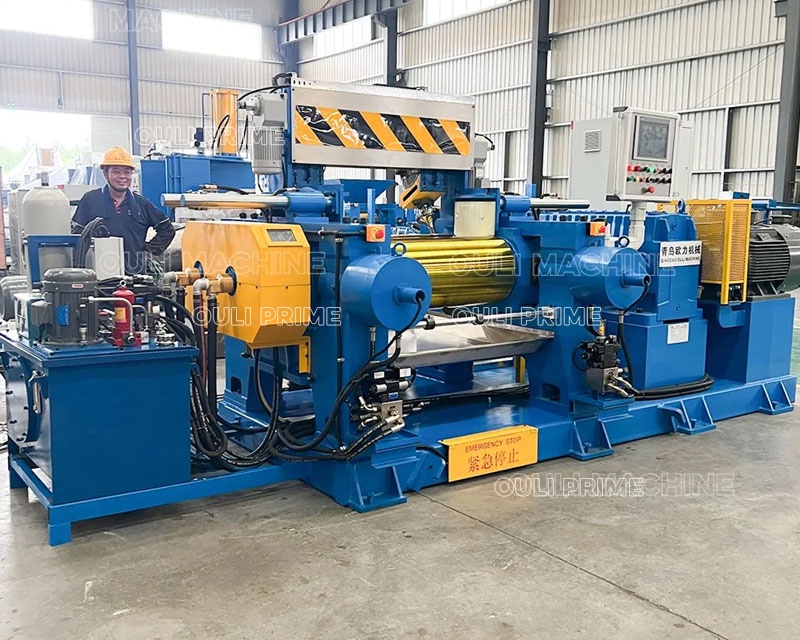
A properly equipped 2 roll mill should come with emergency stop buttons — at minimum four, distributed on both sides of the machine, plus one on the electrical control panel. There should also be a kick stop device. These are not optional accessories; they're fundamental to safe operation.
Beyond the basics, there are additional safety features worth considering. Chest-bump emergency stops positioned at operator height. Pull-rod emergency stops along the length of the machine so an operator can trigger a stop from anywhere along the nip. Safety light curtains that create an invisible barrier — if anything breaks the beam, the mill stops instantly. I've seen facilities go with just the basics and then retrofit the extras after a close call. Don't wait for a close call.
Bearing Lubrication — Automatic Is Worth Every Penny
Here's a detail that separates a well-maintained mill from one that's constantly breaking down: the bearing lubrication system. Automatic dry oil lubrication — using lithium-based grease — with programmable timing and frequency settings. You set it once, and it runs. No manual greasing schedules to track, no missed service intervals, no operators who skip greasing because they're behind on production.
The difference in bearing life between a mill with automatic lubrication and one without is significant. I've pulled bearings off mills that had manual greasing after just a couple years of production use — contaminated grease, over-greasing that forced seals past their limits, under-greasing that led to metal-on-metal contact. An automatic system delivers the right amount at the right interval, every time.
Frame and Structure — The Foundation You Can’t See
The frame and base of a 2 roll mill are welded and then annealed, followed by precision machining. The steel thickness runs around 240 millimeters. This isn’t about building a tank; it's about controlling vibration and maintaining alignment under load.
When you're processing a 200-kilogram batch at high speed, the forces involved are substantial. A flexible frame will flex, the roller alignment will shift, and your compound quality will vary. I've compared mills side by side — same roller dimensions, same motor power — and the one with the heavier, better-constructed frame produced noticeably more consistent results. The difference was in the vibration dampening. You can feel it just by putting your hand on the frame during operation.
Model Selection — Matching the Machine to Your Actual Needs
The product line spans from the X(S)K-160 with 160mm diameter rollers and a 4 kg/batch capacity up to the X(S)K-660 with 660mm rollers handling 250 to 300 kg per batch. Here's a quick reference:
Picking the right size comes down to your actual batch volume and what you're mixing. A lab doing formulation work might be fine with a 160 or 200 series. A production facility running compound for tire treads or conveyor belts will need something in the 450 to 660 range. But don't oversize just because you think you might need the capacity someday. An oversized mill running small batches wastes energy and makes temperature control harder.
Brake System — Stopping Is as Important as Starting
The braking system on a 2 roll mill needs to be reliable and fast. We're talking about stopping time of about one-quarter revolution from full speed. The brake type is electric-hydraulic, and you'll typically see a combination of bar brakes, chest brakes, stop buttons, and foot brakes. Fast, predictable stopping protects both the operator and the equipment. I've seen what happens when a brake fades — the rollers coast for too long, and someone trying to pull material free gets caught in the nip during that extra rotation.
Questions I Get Asked About 2 Roll Mills
Where are these machines typically manufactured? Most quality open mills come from specialized equipment manufacturers. Qingdao OULI Machine Co., Ltd., for example, operates from the Huangdao District in Qingdao, Shandong Province, China. They've been in this space long enough to have worked through the common design issues.
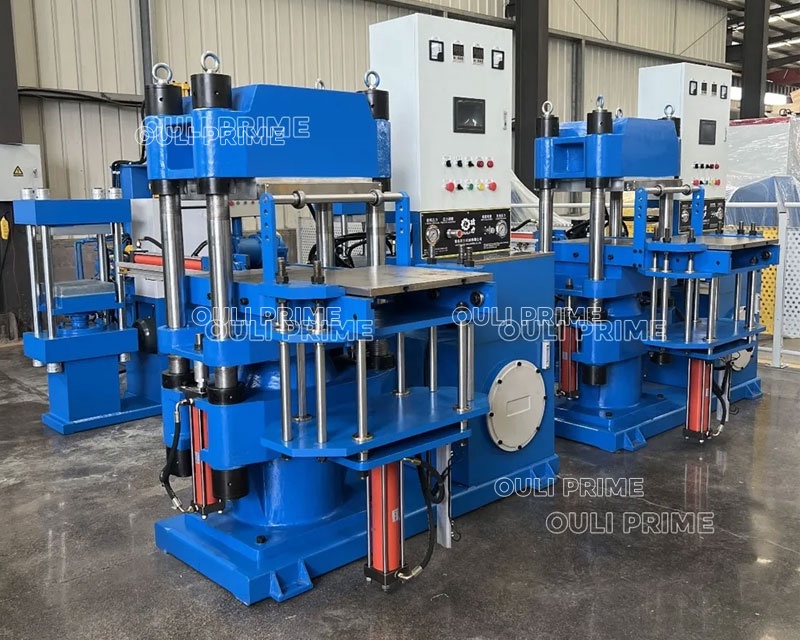
Can one supplier handle an entire rubber processing line? Yes, many manufacturers offer integrated solutions — not just the mill itself but the complete line from mixing through calendering or pressing. That can simplify procurement and technical support.
How do they check quality before shipping? Reputable manufacturers use standard operating procedures throughout production. Each machine typically runs automatically for at least 72 hours before inspection. That runtime test catches a lot of issues that static inspections miss.
What about support after purchase? Good suppliers provide pre-sales engineering support — machine selection, layout planning, utilities requirements. Post-sale, they should have engineers available for overseas installation, commissioning, and operator training. Spare parts packages are typically included with each machine shipment.
How long does delivery take? For standard configurations, anywhere from 10 to 30 days depending on the model and options. Custom configurations naturally take longer.
What's the warranty situation? A typical warranty period runs 12 months for the whole machine, with key parts possibly having different terms. Always read the fine print.
Final Thoughts
The 2 roll mill isn't the newest technology in rubber processing. You won't find it in glossy marketing brochures alongside AI-controlled continuous mixers. But walk into any serious rubber compound development lab or small-to-medium production facility, and you'll find one working on the floor. It's reliable, it's versatile, and when properly specified and maintained, it produces consistent results batch after batch.
If you're evaluating a 2 roll mill for your operation, focus on the things that actually matter: roller material and hardness, bearing type and lubrication system, nip adjustment precision, safety features, and the overall structural rigidity of the frame. Those are the details that separate a machine that lasts from one that becomes a maintenance headache.
The ones I've worked with over the years that gave the strongest return on investment weren't necessarily the most expensive. They were the ones built with proper materials, sensible engineering, and enough safety features that operators actually felt comfortable using them correctly. That's worth paying attention to when you're making your selection.

leave your message