Rubber Milling
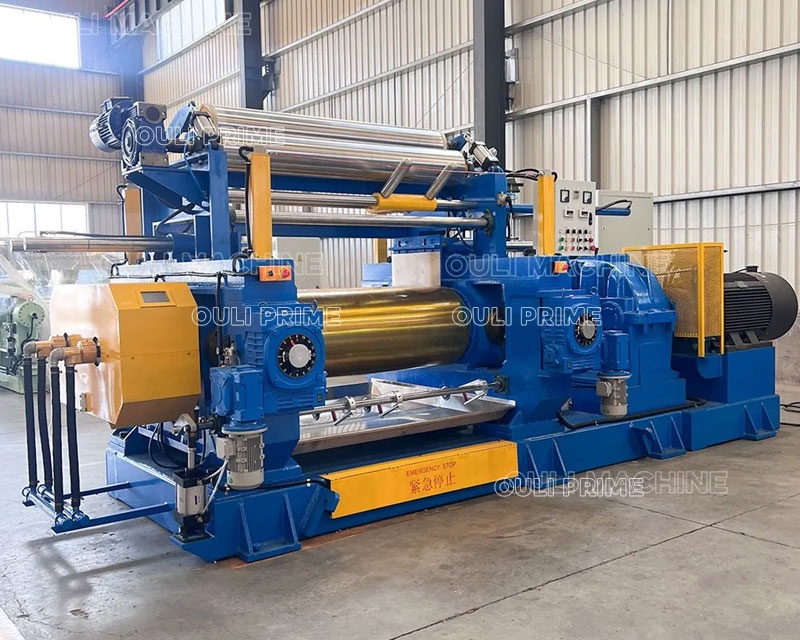
Precision, Efficiency, and Safety in Modern Rubber Milling
In the rubber and plastic processing industry, rubber milling remains a foundational process for transforming raw polymers into usable compounds. As a technical R&D engineer at Qingdao OULI Machine, I have seen how the right rubber mixing mill directly impacts batch consistency, energy consumption, and operator safety.
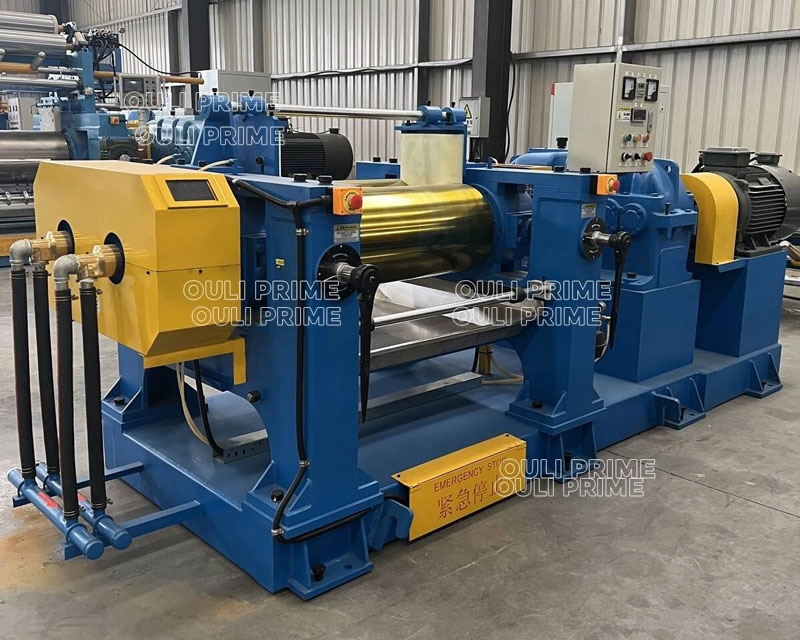
Rubber milling—often performed on a two-roll open mixing mill—involves shearing, blending, and kneading raw rubber, synthetic rubber, thermoplastics, or EVA with additives such as carbon black, sulfur, accelerators, and plasticizers. The goal is to achieve a homogeneous, uniform mixture that feeds seamlessly into calenders, hot presses, or extrusion lines.
Why Rubber Milling Still Matters
While continuous mixers and internal mixers exist, the open two-roll mill remains essential for:
- Masterbatch and final mix preparation – especially for small-to-medium batches or color compounds.
- Warm-up and sheeting of rubber stock before calendering or molding.
- Quality control sampling – milling allows quick adjustments to formulation without wasting material.
- Laboratory and pilot production – where flexibility and visibility of the mix are critical.
Key Technical Parameters That Define a High-Performance Rubber Milling Mill
From an engineering standpoint, not all two-roll mills deliver the same results. When evaluating rubber milling equipment, consider these core specifications:
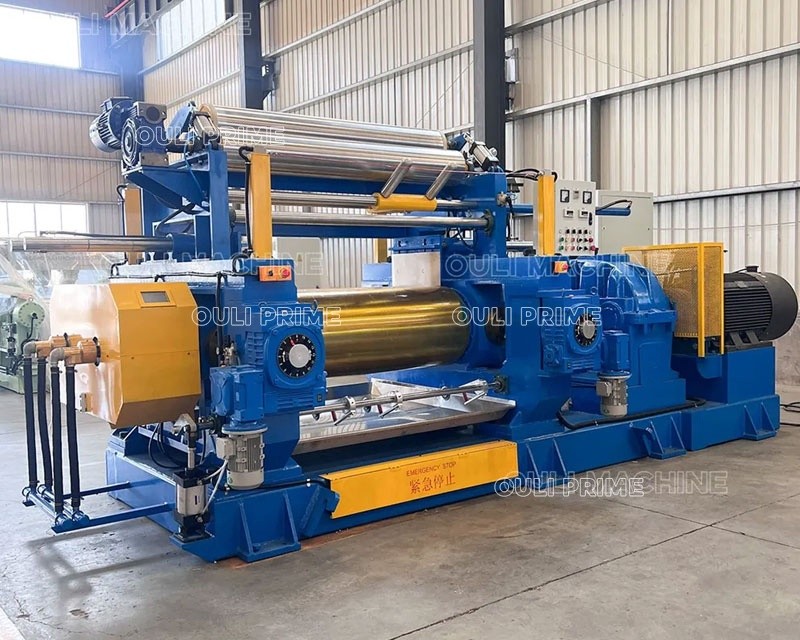
Innovation in Rubber Milling: Automatic Stock Blender Integration
Modern rubber milling lines often integrate an automatic stock blender above the two rolls. This device:
- Continuously cuts, folds, and re‑feeds the rubber strip
- Eliminates manual cutting and turning (reducing labor and repetitive strain injuries)
- Ensures uniform dispersion of ingredients, especially with high-viscosity or tacky compounds
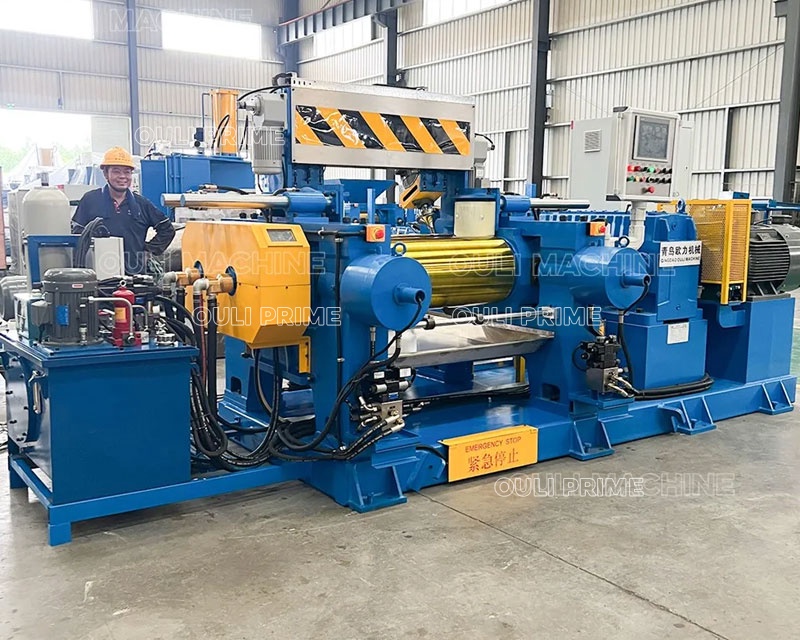
At Qingdao OULI Machine, our automatic stock blender features chrome-plated rollers, independent frequency control for both blender rolls, and hydraulic drive. The result: shorter mixing cycles and batch-to-batch consistency that manual milling cannot achieve.
How to Choose a Rubber Milling Mill for Your Operation
Based on real customer inquiries, here is a decision framework:
1. Batch size – For batches <50 kg, a 14‑16 inch roll length is sufficient. For production >100 kg, consider 18‑22 inch or custom sizes.
2. Material type – Abrasive fillers (silica, carbon black) require higher roll hardness (≥72 HSD). Sticky compounds benefit from chrome plating or mirror finishing.
3. Safety requirements – In regions with strict CE or local standards, prioritize mills with redundant safety (chest bar + light curtain + foot brake).
4. Automation level – Automatic nip adjustment, PLC-controlled mixing cycles, and data logging reduce operator dependence.
5. Energy cost – Rolling bearings + hard tooth gearbox can lower electricity use by 5–10% over a nylon‑bushing mill.
Industry Trends Shaping Rubber Milling
- Energy monitoring – Mills are now paired with sensors to track specific energy consumption per batch.
- Predictive maintenance – Vibration and temperature sensors on bearings and gearboxes.
- Operator‑free zones – Fully enclosed milling lines with remote control, especially for highly toxic or volatile compounds.
- Low‑noise design – Helical gears and isolated frames meet sub‑85 dB(A) requirements.
At Qingdao OULI Machine, we have applied these trends to our automatic stock blender type two‑roll rubber open mixing mills. Every machine undergoes a minimum 72‑hour continuous test run before shipment, with all parameters documented.
Final Engineering Recommendation
Rubber milling is both an art and a science. A rigid frame, hard‑chilled rolls, reliable bearings, and effective safety systems form the foundation. But the true differentiator is how well the mill integrates with your upstream mixer and downstream calender – and how safely your operators can work.
---
About the Author
Wang Lei, Senior R&D Engineer at Qingdao OULI Machine Co., Ltd. With 14 years in rubber machinery design, Wang holds 6 patents in two‑roll mill safety systems and automatic stock blending. He leads OULI’s compliance team for CE and GOST certification and has personally commissioned over 200 rubber milling lines across Southeast Asia, the Middle East, and South America.
---
FAQ: Rubber Milling
Q1: What is rubber milling in the context of rubber processing?
Rubber milling is the mechanical process of shearing, blending, and kneading raw rubber (natural or synthetic) with additives like carbon black, sulfur, and plasticizers using a two‑roll mixing mill. The goal is to produce a homogeneous rubber compound ready for calendering, extrusion, or molding.
Q2: What is the difference between a rubber mixing mill and a rubber milling machine?
The terms are used interchangeably. A “rubber mixing mill” typically emphasizes the blending function, while “rubber milling machine” focuses on the size reduction or dispersion action. Both refer to the same open two‑roll equipment.
Q3: What safety features should a modern rubber milling mill have?
At minimum: multiple emergency stop buttons on both sides (within easy reach), a foot/kick stop bar, electric‑hydraulic brake that stops the rolls within ¼ revolution. Optional but recommended: chest bump bar, pull‑cord, safety light curtains, and two‑hand operation controls.
Q4: How often should the roller bearings be lubricated on a rubber milling mill?
With an automatic dry oil (lithium grease) system, you can set lubrication intervals based on operating hours – typically every 8–12 running hours for heavy use. Without automation, manual lubrication should be performed daily before startup.
Q5: Can a rubber milling mill handle silicone rubber or other specialty elastomers?
Yes, with modifications: chrome‑plated or mirror‑finished rolls to prevent sticking, variable frequency drive (VFD) for lower friction speeds, and often a dedicated cooling system because silicone generates less heat.
Q6: What is the typical hardness of rubber milling mill rolls, and why does it matter?
High‑quality rolls have a chilled layer hardness of 72–75 HSD (Shore D). Harder rolls resist scoring from abrasive fillers (carbon black, silica) and maintain a consistent nip gap for thousands of hours. Softer rolls wear faster and lead to uneven sheet thickness.
Q7: How do I know if I need an automatic stock blender on my rubber milling mill?
If your mixing cycle requires frequent manual cutting, folding, and turning of the rubber strip (more than once every 2 minutes), or if you struggle with batch‑to‑batch variation, an automatic stock blender is recommended. It reduces labor and improves dispersion uniformity.
Q8: What is the average delivery time for a rubber milling mill from Qingdao OULI Machine?
For a standard, non‑customized two‑roll open mixing mill, delivery is typically 10–30 days after order confirmation. Custom options (e.g., special roll finish, hydraulic nip adjustment, safety light curtains) may extend lead time by 2–4 weeks.
Q9: Does Qingdao OULI Machine provide on‑site commissioning and training?
Yes. OULI has a team of experienced field engineers who travel internationally to assist with installation, commissioning, and worker training. We also provide detailed SOPs and remote support.
Q10: What warranty is offered on a rubber milling mill?
The entire machine is warranted for 12 months. Key components (rolls, bearings, gearbox) may have extended coverage depending on the usage and maintenance records. Spare parts are supplied with every machine.
---
This article is based on engineering data from Qingdao OULI Machine’s automatic stock blender two‑roll rubber open mixing mill series. For technical specifications or a quotation, please visit our product page or contact our pre‑sales team.

leave your message