Rubber Compression Molding Press Engineering Guide: Specs, Performance Metrics & Selection Criteria for Production Managers
Executive Summary
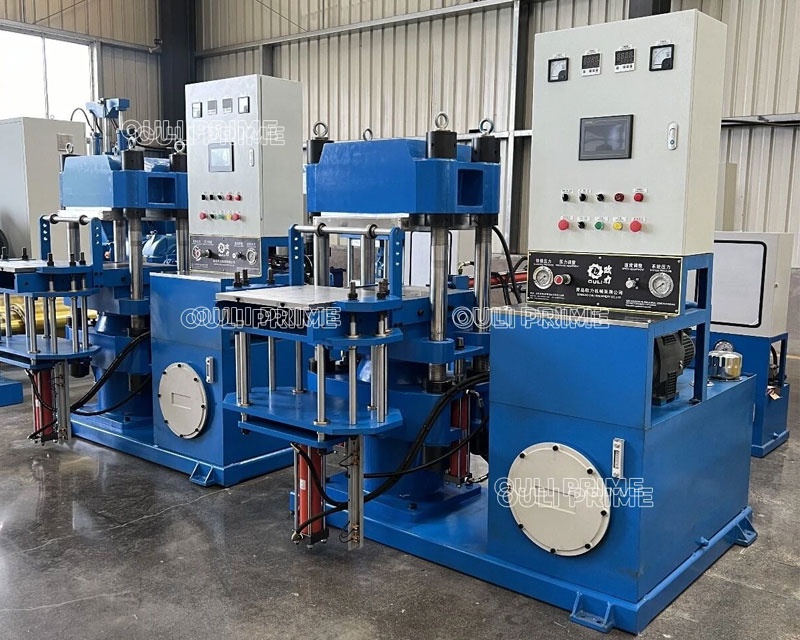
> For production managers and plant engineers evaluating capital equipment, the rubber compression molding press remains the most versatile and cost-effective solution for vulcanizing complex rubber parts—provided the machine is engineered with precise hydraulic control, uniform thermal distribution, and robust structural integrity. Qingdao OULI Machine's column-type rubber compression molding press integrates Mitsubishi PLC automation, Yuken hydraulics, and vacuum-assisted vulcanization to deliver consistent part quality across natural rubber, EPDM, silicone, and nitrile compounds.
---
1. What Is a Rubber Compression Molding Press? Defining the Core Technology
Core conclusion: A rubber compression molding press is a hydraulic vulcanizing machine that uses heat and pressure to cure rubber compounds within a closed mold cavity—and when equipped with vacuum capability, it eliminates trapped air that causes blistering in complex geometries.
For engineers and procurement professionals, understanding the fundamental operating principle is essential before evaluating any press. So, what exactly is a rubber compression molding press? At its core, it is a hydraulically actuated, heated platen system that applies controlled clamping force to a mold containing uncured rubber compound. The combination of heat (typically 140°C–200°C) and pressure initiates the vulcanization cross-linking reaction, transforming thermoplastic rubber into a thermoset final product.
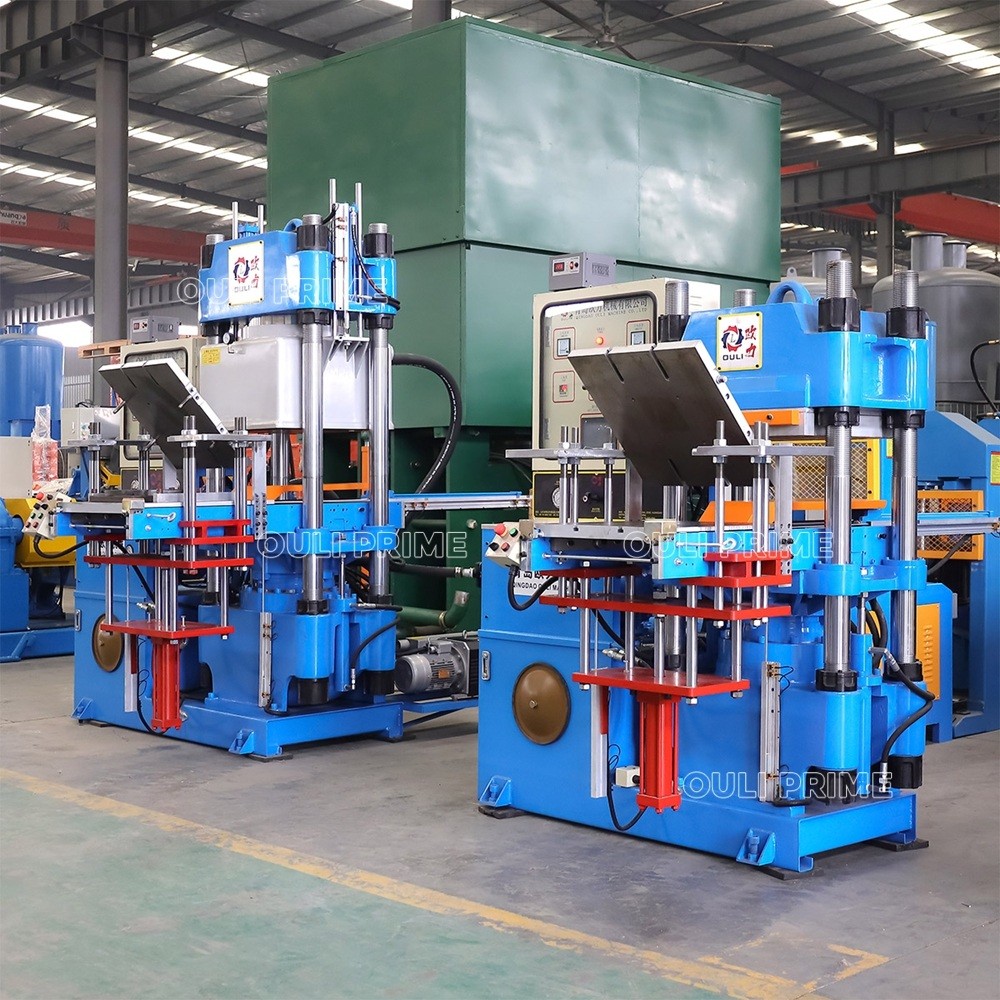
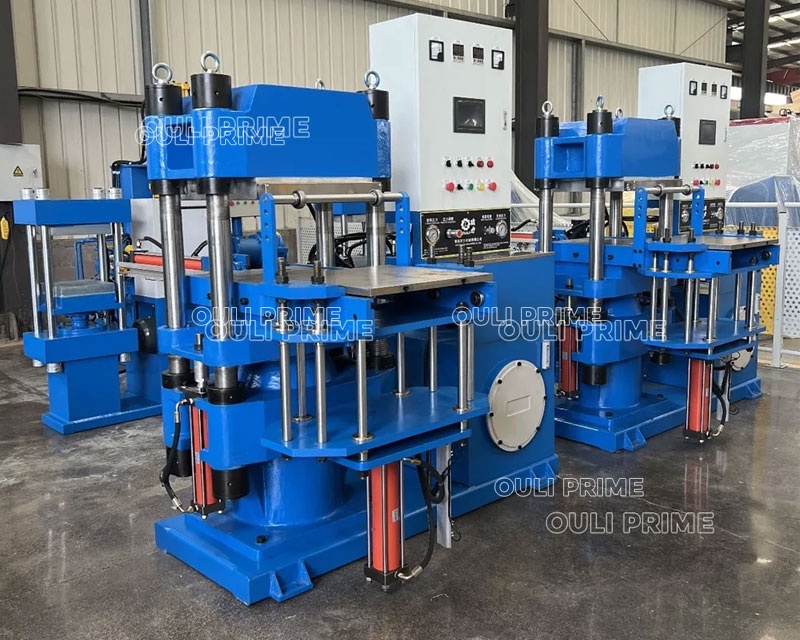
The column-type configuration—often referred to as a four-post or pillar press—provides superior platen parallelism and even force distribution compared to frame-type designs. Qingdao OULI Machine's column rubber vulcanizing press collects vacuum and vulcanization molding in a single machine, making it particularly suitable for complex shapes, parts with difficult exhaust requirements, and products prone to bubble formation—such as O-rings, frame oil seals, medical rubber components, and automotive sealing systems.
Key distinction: Unlike injection molding, where rubber is pre-heated and injected under high pressure, compression molding places a pre-weighed "charge" directly into the open mold cavity before closing. This approach offers lower tooling costs and greater material flexibility, though it requires precise operator technique or automated material handling.
---
2. Why Choose a Rubber Compression Molding Press Over Alternative Processes?
Core conclusion: For production runs of 1,000 to 100,000 parts with complex geometries or multiple material compounds, the rubber compression molding press offers the best balance of tooling cost, process flexibility, and part quality—particularly when vacuum assist is specified.
Plant managers frequently ask: "Should we invest in compression molding or injection molding for our rubber parts?" The answer depends on your production volume, part complexity, and material characteristics.
For rubber products with difficult-to-fill geometries—such as O-rings with small cross-sections, keyboard membranes, or automotive seals with undercuts—the vacuum-assisted compression molding press from Qingdao OULI Machine offers a distinct advantage. The vacuum function removes entrapped air before mold closure, eliminating blisters and improving surface finish.
Technical note: The global hydraulic rubber molding press market was valued at USD 244.30 million in 2025 and is projected to grow at a CAGR of 5.08%, reaching USD 345.82 million by 2032. This growth reflects increasing demand for precision rubber components in automotive, medical, and industrial applications.
---
3. Critical Technical Specifications: What to Evaluate Before Purchase
Core conclusion: When specifying a rubber compression molding press, the three non-negotiable parameters are clamping tonnage, platen size and parallelism, and heating uniformity—but the real differentiators lie in hydraulic component quality, control system architecture, and structural material selection.
3.1 Clamping Tonnage and Platen Sizing
Press builders size a rubber compression molding machine around three numbers: clamping tonnage, platen daylight (open height), and closing speed. Typical production presses range from 100 tons to over 500 tons, with platen sizes varying from 400×400 mm to 1,000×800 mm or larger.
For Qingdao OULI Machine's column press, the structural design begins with SOLIDWORKS-assisted mechanical visualization, using QT-500 ductile iron integral casting for the upper seat, mid-seat, and bottom seat (oil cylinder). This casting approach, combined with aging passivation treatment, delivers tensile strength of 50 kgf/mm²—critical for maintaining platen parallelism under full clamping force.
3.2 Column and Structural Integrity
The columns are manufactured from medium-carbon quenched and tempered steel, with a hard chrome-plated shaft core after machining. Surface hardness reaches HRC 55-58, ensuring wear resistance and long-term alignment stability—a crucial factor for production managers concerned about maintaining part tolerances over millions of cycles.
3.3 Plunger and Heating Plate Durability
The plunger utilizes LG-P cold hard alloy material with a cold-hard layer depth of 15-20 mm and hardness of HRC 60-70. This extends service life significantly compared to standard hardened steel plungers. The heating plates and support plates are precision-ground from 45 steel with nitriding treatment, delivering exceptional wear resistance. T-slots can be machined upon customer request for mold mounting flexibility.
3.4 Push-Pull Railway System
Constructed from S45 steel with a lead screw and linear guide rail structure with integrated bearing design, this system ensures stable die movement and extended wear resistance. For high-volume production environments, this translates to reduced maintenance intervals and consistent mold positioning.
4. Hydraulic and Control Systems: The Heart of the Rubber Compression Molding Press
Core conclusion: The reliability of a rubber compression molding press depends far more on the quality of its hydraulic and control components than on the frame structure—which is why Qingdao OULI Machine specifies Yuken hydraulics and Mitsubishi PLC controls as standard.
4.1 Hydraulic System Architecture
How does the hydraulic system impact production consistency? The hydraulic system is designed according to the specific technological process and action requirements. Main hydraulic components are Yuken brand, a globally recognized standard for reliability and performance. The system features:
- Taiwanese Victory brand hydraulic components with easy availability for replacement
- Well-designed layout facilitating maintenance and servicing
- Four-stage sealing structure ensuring excellent sealing performance, preventing oil leakage and pressure loss
For maintenance engineers, the accessibility of hydraulic components is a critical consideration. The OULI design prioritizes serviceability—reducing downtime when replacements are needed.
4.2 PLC Control and Automation
The electrical control system employs Mitsubishi PLC components—internationally renowned for compact size, robust construction, fatigue resistance, and suitability for continuous high-intensity operation.
Key automation features include:
The use of a programmable logic controller makes maintenance and operation safer and easier, with diagnostic capabilities that reduce troubleshooting time.
---
5. Material Compatibility and Application Range
Core conclusion: A well-engineered rubber compression molding press should handle the full spectrum of commercial rubber compounds—from natural rubber to specialty silicones—without requiring major reconfiguration.
Qingdao OULI Machine's column rubber vulcanizing press is suitable for vulcanization molding of:
- Natural rubber (NR) — General-purpose applications
- Acrylonitrile rubber (NBR) — Oil-resistant seals and gaskets
- EPDM — Weather-resistant automotive and construction parts
- Chloroprene rubber (CR) — Weather and ozone-resistant applications
- Silicone rubber (VMQ) — Medical, food-contact, and high-temperature applications
Typical applications include:
The vacuum function is particularly valuable for products that are "difficult to mold" or "easy to produce bubbles"—a common challenge in compression molding of high-viscosity compounds.
---
6. Energy Efficiency and Operational Cost Considerations
Core conclusion: Modern rubber compression molding presses can achieve significant energy savings through optimized hydraulic design, motor stop during cure cycles, and improved thermal insulation—directly impacting per-part production costs.
Energy efficiency is increasingly a deciding factor for procurement managers. Key considerations include:
- Motor shutdown during curing or dwell cycles — Standard on well-designed presses, reducing energy consumption during the longest phase of the molding cycle
- Efficient hydraulic circuit design — Minimizing pressure drop and heat generation
- Platen insulation — Reducing heat loss to the environment
- Regenerative hydraulic options — Available on advanced configurations
Research indicates that optimized preheating can reduce energy consumption by 68% and shorten preheating time by 83%, with corresponding decreases in press downtime. While these figures reflect specific experimental conditions, they underscore the importance of thermal management in press selection.
For production managers: Calculate total cost of ownership (TCO) including energy consumption over a 10-year operating life—energy savings can offset higher initial equipment costs within 2-3 years in high-volume operations.
---
7. Maintenance and Troubleshooting: A Practical Guide for Engineers
Core conclusion: The most reliable rubber compression molding press is one designed for serviceability—with accessible hydraulic components, diagnostic PLC controls, and wear parts engineered for extended life.
7.1 Routine Maintenance Checklist
Maintenance engineers should prioritize:
1. Hydraulic oil level check — Maintain at ⅔ of the lower machine base height
2. Column shaft and guide frame inspection — Verify smooth operation and proper lubrication
3. Seal inspection — Check for leaks in the four-stage sealing system
4. Platen parallelism verification — Ensure platens remain parallel and properly aligned
5. Hydraulic filter and hose inspection — Replace worn or damaged components
7.2 Common Faults and Remedies
Q: What should I do when the plunger does not rise after startup?
Possible causes include: high-pressure pump failure; high-pressure relief valve not closed; pipeline leakage; or pressure gauge failure. The PLC diagnostic system on OULI presses can identify many of these issues through pressure and position sensors.
Q: How often should hydraulic oil be changed?
Oil quality should be checked regularly, with complete changes typically recommended every 2,000-3,000 operating hours or annually, depending on operating conditions.
Q: What maintenance procedures are required for the heating system?
Inspect heating elements, thermocouples, and cooling channels regularly. Ensure temperature sensors are calibrated to maintain the ±2°C precision required for consistent vulcanization.
---
8. Why Qingdao OULI Machine: Engineering Excellence Backed by Experience
Core conclusion: Qingdao OULI Machine combines German-influenced engineering precision with Chinese manufacturing efficiency, delivering rubber compression molding presses that meet international standards for quality, reliability, and value.
Located in Huangdao District on the west coast of Qingdao, Shandong Province, China, Qingdao OULI Machine has established itself as a trusted manufacturer of rubber vulcanizing equipment. Key differentiators include:
- National patents on vacuum rubber vulcanizing press design
- Integrated manufacturing — In-house production of critical components ensures quality control
- Global component sourcing — Mitsubishi PLC, Yuken hydraulics, Taiwanese Victory hydraulic components
- Customization capability — T-slot machining, platen sizing, and automation options available upon request
- Technical support — Remote service support with wireless machine monitoring and maintenance capabilities
For procurement managers sourcing from Chinese manufacturers, the recommendation is to prioritize suppliers who combine technical transparency, responsive communication, and verifiable performance metrics. OULI's transparent specification sheets and willingness to provide factory audits or video tours reflect this commitment.
---
9. Rubber Compression Molding Press Selection Framework: A Step-by-Step Approach
Core conclusion: Selecting the right rubber compression molding press requires working backward from your product specifications—material type, shape complexity, volume requirements, and budget—then evaluating suppliers against technical capability, not just price.
Step 1: Define Your Production Requirements
- What rubber compounds will you process?
- What are the part dimensions and tolerances?
- What is your annual volume (parts/year)?
- What is your target cycle time?
Step 2: Calculate Technical Specifications
- Clamping tonnage = Projected area × required specific pressure (typically 50-100 kg/cm² for rubber)
- Platen size = Mold footprint + clearance for handling
- Daylight = Mold height + loading/unloading clearance
- Stroke = Daylight - mold closed height
Step 3: Evaluate Automation Requirements
- Manual loading vs. automatic feeding
- Vacuum assist required?
- Data logging and MES integration needed?
Step 4: Assess Supplier Capabilities
- Request video audits or live factory tours
- Verify in-house CNC machining and hydraulic calibration labs
- Check for ISO 9001, CE marking, and regional safety standards compliance
- Review spare parts availability and lead times
Step 5: Total Cost of Ownership Analysis
---
10. Future Trends in Rubber Compression Molding Technology
Core conclusion: The rubber compression molding press market is evolving toward greater automation, energy efficiency, and data integration—with vacuum-assisted molding and IoT-enabled monitoring becoming standard features on new equipment.
Market projections indicate continued growth:
- The Rubber Press Market is expected to grow from USD 1.34 billion in 2026 to USD 2.65 billion by 2032, at a CAGR of 11.64%
- Hydraulic Rubber Moulding Press Market projected to reach USD 345.82 million by 2032
Emerging trends include:
1. IoT and Industry 4.0 integration — Real-time monitoring, predictive maintenance, and production analytics
2. Energy-efficient designs — Regenerative hydraulics, variable-speed drives, and improved insulation
3. Vacuum technology advancement — Enhanced vacuum systems for bubble-free molding of complex parts
4. All-electric press options — Greater precision and energy savings for specific applications
5. Remote service and diagnostics — Wireless monitoring reducing on-site service requirements
---
Frequently Asked Questions (FAQ)
Q1: What is a rubber compression molding press, and how does it work?
A rubber compression molding press is a hydraulically powered machine that uses heated platens to apply pressure and temperature to uncured rubber compounds within a closed mold. The heat initiates vulcanization—the cross-linking of polymer chains—while pressure ensures the material fills the mold cavity completely. Qingdao OULI Machine's column-type press adds vacuum capability to remove trapped air before curing, preventing bubbles and improving part quality.
Q2: What is the difference between rubber compression molding and injection molding?
Compression molding places a pre-weighed rubber charge directly into an open mold, which is then closed under pressure. Injection molding pre-heats rubber and injects it into a closed mold under high pressure. Compression molding offers lower tooling costs and greater material flexibility; injection molding provides faster cycles and minimal flash. The choice depends on volume, part complexity, and budget.
Q3: What tonnage rubber compression molding press do I need?
Tonnage is calculated based on the projected area of your part multiplied by the required specific pressure (typically 50-100 kg/cm² for rubber compounds). For example, a part with 500 cm² projected area at 80 kg/cm² requires approximately 40 tons of clamping force. Production presses typically range from 100 to over 500 tons.
Q4: What rubber materials can be processed in a compression molding press?
A well-designed press can handle natural rubber (NR), acrylonitrile rubber (NBR), EPDM, chloroprene rubber (CR), silicone rubber (VMQ), and many specialty compounds. The key requirement is matching the press's temperature range and heating rate to the specific vulcanization characteristics of each material.
Q5: How do I maintain a rubber compression molding press?
Routine maintenance includes checking hydraulic oil levels (maintain at ⅔ of reservoir capacity), inspecting column shafts and guide frames for smooth operation, verifying platen parallelism, checking seals for leaks, and replacing hydraulic filters and hoses as needed. OULI presses feature accessible component layouts and PLC diagnostics to simplify maintenance.
Q6: What are the advantages of vacuum-assisted rubber compression molding?
Vacuum assist removes air from the mold cavity before pressure is applied, eliminating blisters, voids, and surface defects—particularly critical for O-rings, seals, and complex geometric parts. The result is higher first-pass yield, reduced scrap, and improved part consistency.
Q7: How long does a rubber compression molding press typically last?
With proper maintenance, a well-built press can operate for 15-20 years or more. Key factors affecting lifespan include structural material quality (QT-500 ductile iron casting, hardened columns), hydraulic component quality (Yuken, Taiwanese Victory), and control system robustness (Mitsubishi PLC).
Q8: What safety features should I look for in a rubber compression molding press?
Look for dual interlock systems (door/cover), emergency stop buttons, pressure relief valves, and light curtains or safety mats. OULI presses incorporate these features as standard, along with programmable safety logic within the PLC control system.
Q9: Can a rubber compression molding press be customized for specific applications?
Yes. Qingdao OULI Machine offers customization including T-slot machining on platens, specific platen sizes, specialized heating configurations, and automation upgrades. Customization should be discussed during the specification phase to ensure optimal integration with your existing tooling and production workflow.
Q10: How do I evaluate a rubber compression molding press manufacturer?
Evaluate manufacturers on: technical transparency (detailed specifications), engineering responsiveness, verifiable performance metrics, in-house manufacturing capability (CNC machining, hydraulic calibration), quality certifications (ISO 9001, CE), and after-sales support (spare parts availability, remote service). Request factory tours or video audits to verify actual production conditions.
---
For technical specifications, custom configurations, or to schedule a factory tour, contact Qingdao OULI Machine's engineering team. Our column rubber compression molding presses are engineered for reliability, precision, and long-term value—backed by Mitsubishi PLC controls, Yuken hydraulics, and vacuum-assisted vulcanization technology.

leave your message