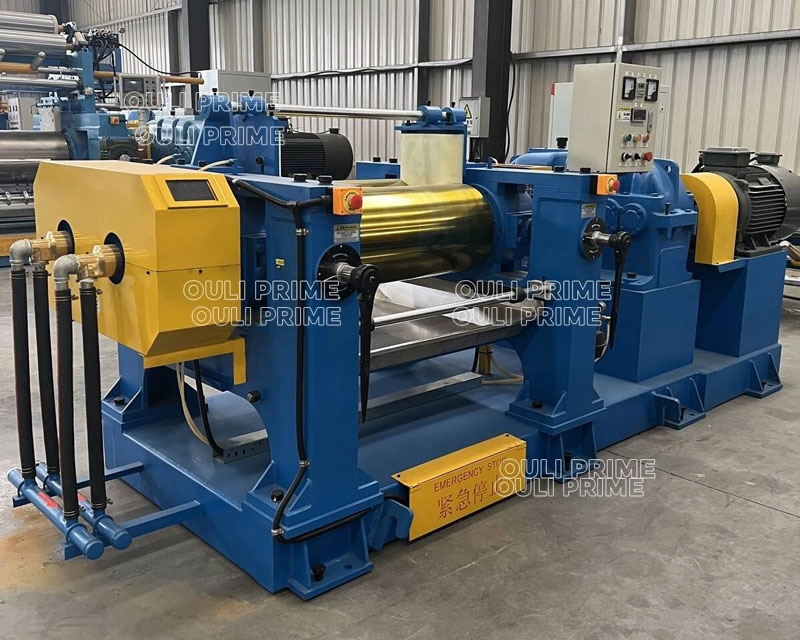
Stock Blender Open Type Two Roll Rubber Mixing Mill Machine
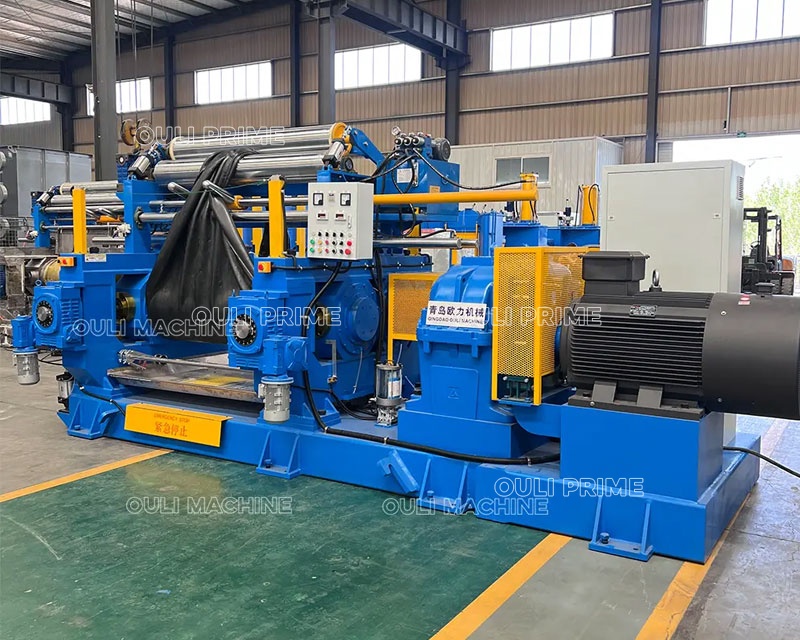
Core takeaway: The stock blender open type two roll rubber mixing mill remains the industry’s most versatile workhorse for compounding raw rubber, synthetic rubber, and thermoplastics—offering batch capacities from 1–2 kg up to 250–300 kg with roll diameters ranging from Ø160 mm to Ø710 mm.
Introduction: Why the Rubber Mixing Mill Still Matters in Modern Compounding
Core takeaway: Despite the rise of internal mixers, the two-roll open mixing mill remains indispensable for color changes, small-batch production, high-purity compounds, and formulations sensitive to shear history—precisely because operators can see, feel, and control the compound throughout the mixing cycle.
What is a rubber mixing mill machine? At its simplest, it is a two-roll open mill that blends raw rubber with chemical additives, fillers, and vulcanizing agents through intense mechanical shear and compression. The two horizontally opposed rolls rotate in opposite directions at different speeds. This speed differential—typically a friction ratio between 1:1.1 and 1:1.4—creates the shearing action that breaks down polymer chains and disperses compounding ingredients throughout the batch.
How does a rubber mixing mill work? Raw rubber or a pre-compound is fed into the adjustable nip gap between the two rolls. As the rolls rotate inward toward each other, the rubber is subjected to shear forces, compression, and frictional heat. The compound wraps around the front roll, and operators use hand tools or automated cutting devices to fold, cut, and reintroduce the sheet repeatedly until uniform dispersion is achieved.
For production managers and procurement engineers evaluating capital equipment investments, understanding the technical specifications, performance metrics, and total cost of ownership of a rubber mixing mill machine is essential. This guide provides that depth—from roll metallurgy to safety systems, from batch capacity calculations to supplier evaluation criteria.
Technical Specifications: Understanding What the Numbers Mean
Core takeaway: Specification sheets tell only half the story—the real value lies in understanding how roll material, hardness, speed ratio, and drive system quality translate into compound uniformity, batch consistency, and equipment longevity.
When procurement engineers compare rubber mixing mill machine models, the specification table is usually the starting point. But what do these numbers actually mean for production?
Key Specification Parameters
Roll Metallurgy: The Foundation of Mixing Quality
The rolls are the heart of any rubber mixing mill machine. Qingdao OULI Machine uses LTG-H chromium-molybdenum alloy chilled cast iron with a roll face hardness of 75 HSD. This metallurgical choice matters for three reasons:
1. Wear resistance – Harder roll surfaces maintain their finish longer, reducing the frequency of regrinding and minimizing contamination risks—critical for high-purity silicone or medical-grade compounds.
2. Thermal uniformity – The internal cavity of each roll is precision-machined to ensure consistent temperature distribution across the entire working surface. Temperature variation of ≤ ±2.5°C across the working width is achievable with proper cooling system design.
3. Surface integrity – A ground and polished roll surface ensures consistent rubber adhesion and sheet quality. Surface defects translate directly into compound imperfections.
Drive System: Where Reliability Is Built
The transmission system of a rubber mixing mill machine must withstand continuous shock loads, high torque, and thermal cycling. OULI’s approach uses a hard gear reducer (four-axis three-stage) with gears that are carburized and ground to Grade 6 accuracy.
What does Grade 6 gear accuracy mean for your production line?
- Tighter gear mesh reduces backlash and ensures stable roll speed even under variable load
- Lower noise levels improve operator working conditions
- Reduced vibration extends bearing life and reduces maintenance frequency
The drive motor power must be matched to the batch size and compound viscosity. For a typical X(S)K-400 model (Ø400×1000 mm rolls, 45 kg batch capacity), a 37 kW drive motor is standard.
Safety Systems: Protecting Operators Without Sacrificing Productivity
Core takeaway: Modern rubber mixing mill machines integrate multiple redundant safety systems—emergency brakes, safety pull-rods, and overload protection—that must stop the machine within 1/4 wheel turn while maintaining production efficiency.
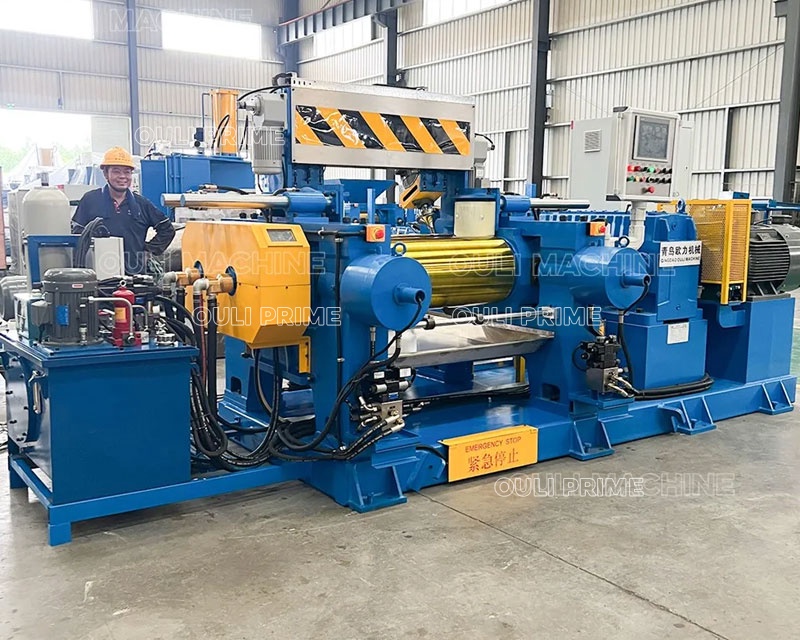
Safety is non-negotiable in rubber compounding. The open nature of two-roll mills means operators work in close proximity to moving machinery. Qingdao OULI Machine addresses this with a multi-layered safety architecture:
Emergency Braking System
The electric-hydraulic brake system stops the rolls within 1/4 wheel turn. This rapid stopping capability is critical during:
- Manual sampling operations
- Additive addition procedures
- Any unexpected operator intervention
Safety Pull-Rod and Foot Brake
When an emergency arises, operators can activate the safety pull-rod or foot brake to stop the machine immediately. These mechanical backups ensure the machine can be stopped even if the electrical system fails.
Overload Protection
The machine is equipped with an overload protection device that prevents damage to main components when excessive torque is applied. This protects both the equipment and the operator.
How do you verify safety system performance during supplier evaluation? Request documented brake response time tests, ask about compliance with EU Machinery Directive 2006/42/EC (CE marking), and confirm that safety interlocks are tested as part of the factory acceptance procedure.
Performance Data: What Third-Party Testing Reveals
Core takeaway: Verified performance data—not marketing claims—should drive equipment decisions; look for quantifiable metrics like uniformity coefficient, temperature stability, and power efficiency.
Qingdao OULI Machine conducted third-party shop tests on the X(S)K-400 model (Ø400×1000 mm rolls, 45 kg batch capacity) processing a standard 50-durometer silicone rubber. The results provide benchmarks that procurement engineers can use for comparison:
These metrics matter because they translate directly into:
- Lower scrap rates – Consistent dispersion means fewer rejected batches
- Faster cycle times – Achieving target UCD in 12 minutes optimizes throughput
- Predictable energy costs – Power efficiency within 11% of theoretical means no hidden energy waste
Stock Blender Integration: Automating the Manual Work
Core takeaway: A stock blender transforms a manual two-roll mill into a semi-automated mixing system—reducing labor requirements, improving batch consistency, and enabling operators to focus on quality control rather than repetitive physical tasks.
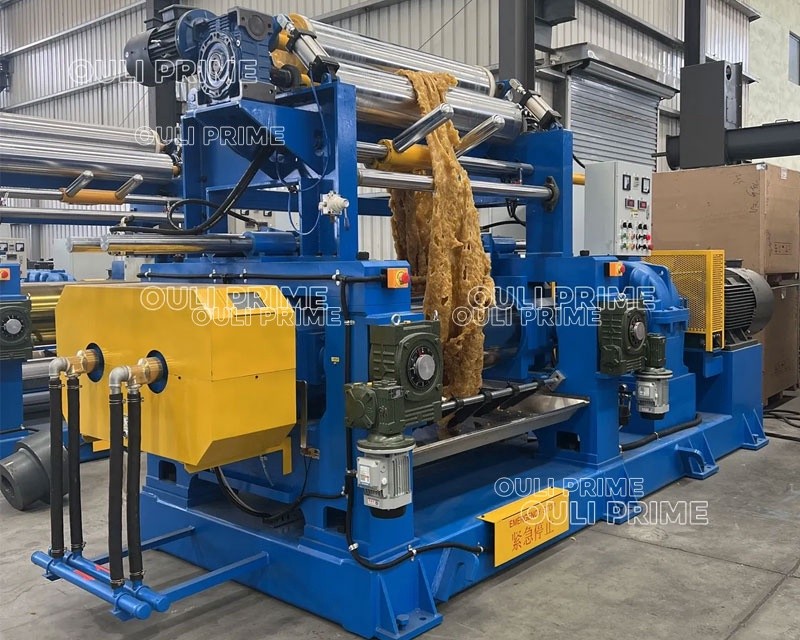
What is a stock blender on a rubber mixing mill? It is an automated attachment that performs the folding, cutting, and reintroducing of the rubber sheet—tasks that would otherwise require constant manual operator intervention.
Benefits of Stock Blender Integration
For production managers, the stock blender delivers predictable, repeatable mixing cycles—which means less variability in compound quality and fewer rejected batches. For procurement engineers, it means lower long-term labor costs and faster return on investment.
Model Range and Capacity Options
Qingdao OULI Machine offers a comprehensive range of rubber mixing mill models to match different production scales:
How do you select the right model? Match the batch capacity to your typical compound batch size, then verify that the roll diameter and length can handle your maximum batch weight without overloading the drive system.
Applications: Where the Rubber Mixing Mill Excels
Core takeaway: The open two-roll mill is uniquely suited for silicone rubber mixing, color changes, small-batch production, and high-purity compounding—applications where internal mixers create contamination risks or lack the necessary process visibility.
Silicone Rubber Compounding
Silicone rubber (VMQ, PVMQ, FVMQ) presents unique challenges: low surface energy, sensitivity to shear history, and a tendency to stick to hot roll surfaces. The open two-roll mill addresses these through:
- Adjustable roll speed ratio (typically 1:1.09 to 1:1.35) – controls shear without excessive heat buildup
- Precise nip gap control – manages compound fluxing behavior
- Uniform roll temperature regulation – prevents sticking or roll fouling
Color Change Operations
For compounders running multiple colors, the open mill’s easy cleaning between batches is a significant advantage. Unlike internal mixers that require extensive purging between color changes, an open mill can be cleaned visually and mechanically in minutes.
High-Purity and Medical-Grade Compounds
The roll surface hardness of 75 HSD and the use of chromium-molybdenum alloy minimize wear particle generation, reducing contamination risk for medical tubing, stoppers, and food-contact silicone articles.
Common End Products
Compounds mixed on two-roll mills feed into:
- Tire manufacturing (inner liners, tread compounds)
- Industrial sealing systems (gaskets, O-rings, profiles)
- Medical devices (tubing, stoppers, diaphragms)
- High-voltage insulators
- Food-contact articles
- Keypad and membrane switch components
Supplier Evaluation: What to Look For Beyond the Price Quote
Core takeaway: Price is only one variable—supplier reliability, technical support, documentation quality, and after-sales service determine the true total cost of ownership over a machine’s 15–20 year service life.
Certification and Compliance
Verify that the supplier holds:
- ISO 9001 certification for quality management
- CE marking for compliance with EU Machinery Directive 2006/42/EC
- Machine-specific test reports covering roll hardness, parallelism tolerance (±0.05 mm), and motor overload protection
Production Infrastructure
Suppliers with in-house manufacturing capabilities—dedicated facilities for roller grinding, gear cutting, and electrical panel integration—offer better quality control and greater customization flexibility. Qingdao OULI Machine, established in 1997 with branches in Suzhou and Dalian, maintains full in-house design, manufacturing, and maintenance capabilities.
Performance Metrics That Matter
Qingdao OULI Machine reports a 100% on-time delivery rate, a 66% reorder rate, and ≤3-hour response time, with a minimum order quantity of 1 set.
Documentation Quality
Request sample documentation before purchase. Comprehensive English manuals should include:
- Wiring diagrams
- Lubrication schedules
- Preventive maintenance checklists
- Spare parts lists with part numbers
Maintenance and Total Cost of Ownership
Core takeaway: A well-maintained rubber mixing mill machine delivers 15–20 years of service life; the key is preventive maintenance on rolls, bearings, gearboxes, and safety systems.
Preventive Maintenance Schedule
Common Wear Items and Replacement Intervals
- Roll bearings – Typically 5–8 years depending on load and lubrication
- Gearbox seals – 3–5 years
- Safety system components – Inspect annually; replace as needed
- Roll regrinding – Every 3–5 years depending on compound abrasiveness
Frequently Asked Questions (FAQ)
Q: What is a rubber mixing mill machine?
A: A rubber mixing mill machine is a two-roll open mill used to blend raw rubber, synthetic rubber, thermoplastics, or EVA with chemicals into homogeneous compounds. The final materials are then fed to calendars, hot presses, or other processing equipment for manufacturing rubber or plastic products.
Q: How does a rubber mixing mill work?
A: Two horizontally opposed rolls rotate in opposite directions at different speeds. Raw rubber is fed into the adjustable nip gap between them. The speed differential creates shear and compression forces that break down polymer chains and disperse additives throughout the batch. The compound wraps around the front roll and is repeatedly folded and cut until uniform dispersion is achieved.
Q: What is the difference between an open mill and an internal mixer?
A: An open mill (two-roll mill) exposes the compound to the operator throughout the mixing cycle, allowing visual inspection and manual intervention. It is preferred for small batches, color changes, and shear-sensitive compounds like silicone. An internal mixer (Banbury type) processes larger batches in a closed chamber with higher throughput but less process visibility.
Q: What is a stock blender on a rubber mixing mill?
A: A stock blender is an automated attachment that folds, cuts, and reintroduces the rubber sheet during mixing. It reduces manual labor, improves batch consistency, and enables operators to focus on quality control rather than repetitive physical tasks.
Q: What batch sizes can a rubber mixing mill handle?
A: Batch capacities range from 1–2 kg on laboratory-scale models (XK-160) up to 250–300 kg on production-scale machines. The X(S)K-560 model handles 50–65 kg per batch with a 95 kW drive motor.
Q: What safety features should a rubber mixing mill have?
A: Essential safety features include an emergency brake system that stops rolls within 1/4 wheel turn, safety pull-rods or foot brakes for immediate machine shutdown, overload protection to prevent component damage, and CE marking for compliance with EU Machinery Directive 2006/42/EC.
Q: How do I choose the right rubber mixing mill for my production?
A: Match the batch capacity to your typical compound batch size, then verify roll diameter and length can handle your maximum weight. Consider compound viscosity—higher viscosity requires more power and larger rolls. Evaluate supplier certifications, on-time delivery performance, reorder rates, and documentation quality. Request third-party test data on dispersion uniformity and temperature stability.
Q: What maintenance does a rubber mixing mill require?
A: Daily inspection of roll surfaces for wear, weekly verification of nip gap adjustment and bearing lubrication, monthly testing of safety systems, quarterly drive motor checks, and annual full mechanical inspection by a qualified technician.
Q: What is the typical service life of a rubber mixing mill?
A: With proper preventive maintenance, a quality rubber mixing mill machine delivers 15–20 years of service life. Key factors affecting longevity include roll metallurgy, gear quality, bearing maintenance, and operating conditions.
Q: Why choose Qingdao OULI Machine as a supplier?
A: Qingdao OULI Machine has been manufacturing rubber machinery since 1997, with in-house design, manufacturing, and maintenance capabilities. The company holds ISO 9001 certification, offers CE-marked equipment, and serves clients in over 20 countries including the US, Canada, Australia, and Brazil. OULI provides 100% on-time delivery, ≤3-hour response time, and accepts minimum orders of 1 set for field trials.
Conclusion: Making the Right Investment Decision
Core takeaway: The rubber mixing mill machine remains an essential investment for any rubber compounding operation—and the right choice depends on matching technical specifications to production requirements, verifying supplier credentials, and understanding total cost of ownership.
For production managers, the stock blender open type two roll rubber mixing mill delivers the process visibility, batch flexibility, and compound quality that modern rubber manufacturing demands. For procurement engineers, the key is evaluating suppliers not just on price but on technical capability, documentation quality, and after-sales support.
Qingdao OULI Machine combines decades of manufacturing experience with verified performance data, comprehensive safety systems, and a global service footprint. Whether you are compounding silicone for medical devices, processing EPDM for automotive seals, or running color-change operations for consumer goods, OULI’s rubber mixing mill machines—from the laboratory-scale XK-160 to the production-scale X(S)K-560—offer the reliability and performance that justify the investment.
Ready to discuss your specific mixing requirements? Contact Qingdao OULI Machine for technical consultation, sample testing, or a virtual factory tour.

leave your message