Banbury Mixer Machines: What Rubber Compounders Actually Need to Know Before Buying
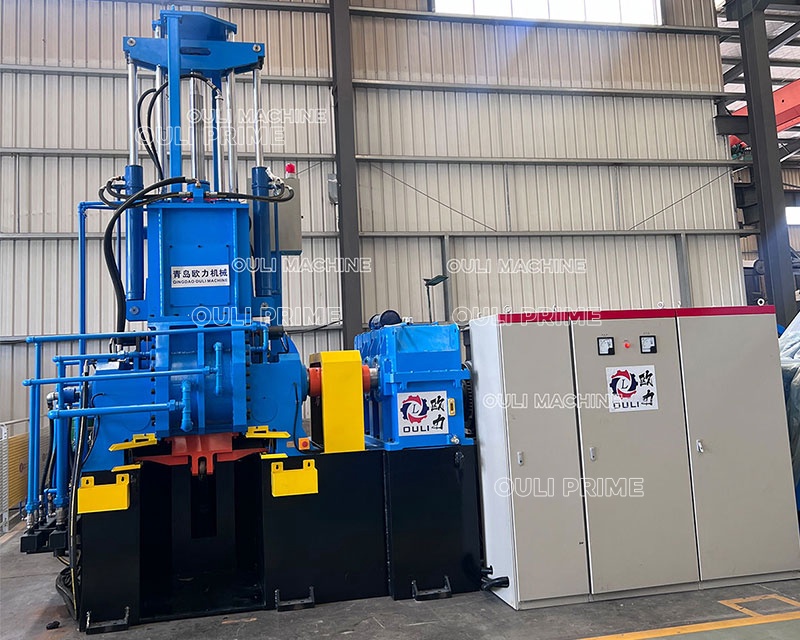
If you’ve spent any time on a rubber processing floor, you’ve probably seen one. It’s that big, heavy piece of equipment with two counter-rotating drums inside a cooled chamber, churning through a batch of compound while the rest of the line waits. The Banbury mixer.
Procurement officers who specify these machines don’t always get the full picture of what actually matters in day-to-day operation. You can look at a spec sheet and see motor power, chamber volume, rotor speed — but those numbers don’t tell you how the machine will behave when you’re running a sticky SBR compound at 60°C ambient temperature, or how easy it is to clean between color changes.
Here’s what I’ve learned from working with Banbury mixers across different facilities, and what I’d want to know if I were specifying one for my plant.
How a Banbury Mixer Actually Works
At its core, a Banbury mixer is an internal mixer. Raw polymer, fillers like carbon black or silica, processing oils, and chemical additives all go into a closed mixing chamber. Two rotors inside the chamber rotate at different speeds — typically with a speed ratio around 1:1.2 — creating shear forces that break down agglomerates and distribute every component throughout the rubber mass.
The rotors intermesh, and as they turn, they trap material between their surfaces and the chamber wall. The gap between rotor and chamber is tight enough to generate significant shear, but not so tight that normal filler particles get damaged. Material gets folded, stretched, and sheared repeatedly until the compound reaches the target temperature and homogeneity.
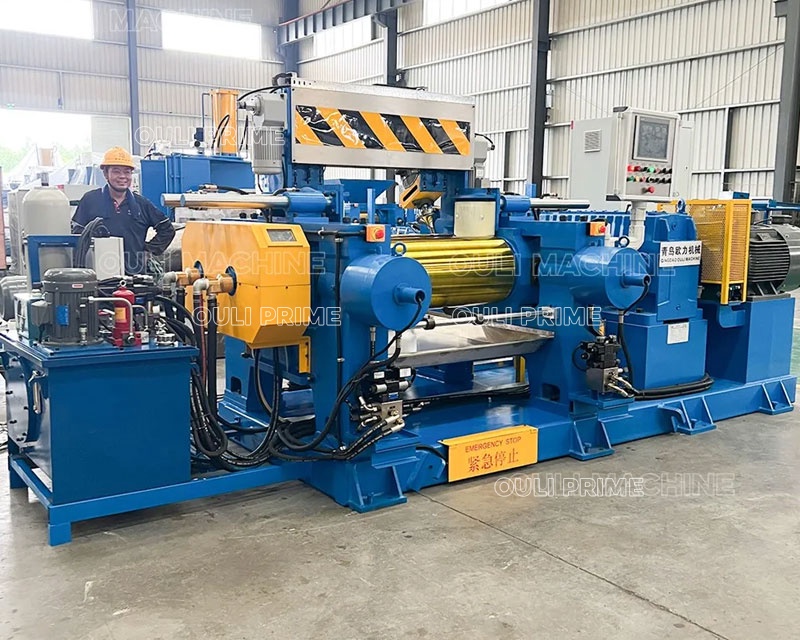
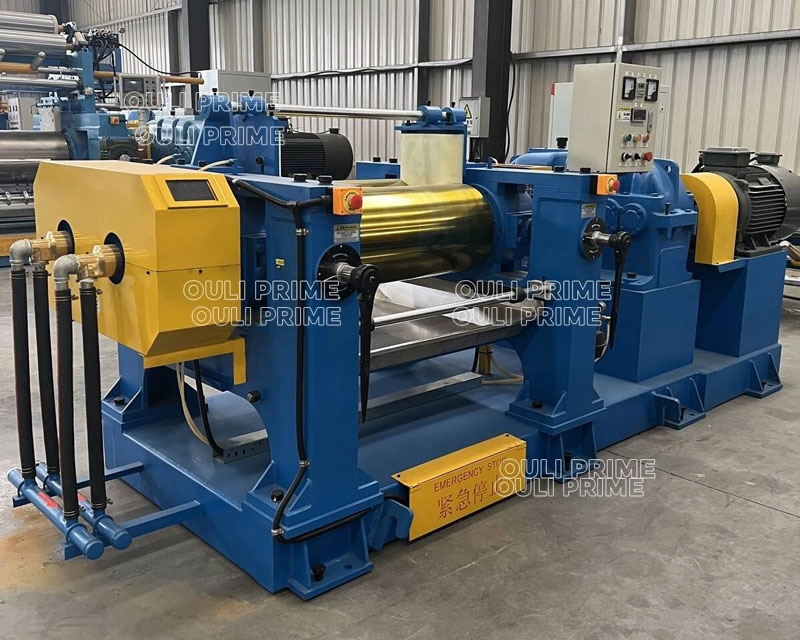
A hydraulic or pneumatic ram presses down on top of the batch, keeping the material submerged and ensuring consistent fill density. Once the mix cycle is complete, a discharge door at the bottom of the chamber opens and the compound drops out, ready for the next stage — usually a two-roll mill for finishing or direct feeding to an extruder.
Chamber Design: Where the Real Mixing Happens
The mixing chamber is the heart of the machine, and its construction tells you a lot about how the mixer will perform over time.
Modern Banbury chambers typically use a drilling-type cooling system — water runs through channels machined directly into the chamber wall. This gives more uniform temperature control than surface cooling alone. The working surface gets hard alloy surfacing, usually 4 to 5 millimeters thick, with hardness at or above 45 HRC. After that, the entire working surface gets a hard chromium plate, roughly 0.10 to 0.15 millimeters thick. This combination handles both abrasion from fillers and the chemical attack from processing compounds.
The chamber isn’t just a hollow cylinder. Its internal geometry — the relationship between rotor diameter, chamber length, and the gap between rotor and wall — determines how material flows through the mix cycle. A longer chamber gives more kneading action but increases residence time. A shorter one cycles faster but may not disperse fillers as thoroughly.
Rotor Configurations and What They Mean for Your Compound
Rotors come in different designs, and the choice affects everything from mixing speed to energy consumption.
Two-wing rotors are the most common configuration. They provide a good balance of shear and kneading for general-purpose compounds — natural rubber, SBR, BR, and their blends. The two-wing design traps and folds material effectively between the rotor lobes and the chamber wall.
Four-wing and six-wing rotors exist for more specialized applications. They generate higher shear rates, which can be useful for breaking down stubborn filler agglomerates or working with particularly viscous compounds. The trade-off is usually higher energy consumption and potentially more heat generation, which means your cooling system has to work harder.
Some manufacturers offer both tangential and intermeshing rotor types. Tangential rotors don’t touch each other — there’s a small gap between them — and they tend to produce gentler mixing with less shear. Intermeshing rotors pass close to each other, creating more intense shear in the gap zone. The choice between these depends on your compound formulation and quality targets.
The rotor body itself is usually cast and hollow, with water circulating through the inner cavity to control rotor temperature. This matters because rotor temperature affects the compound’s viscosity and, ultimately, the dispersion quality.
Key Specifications That Actually Matter
When you’re reviewing a Banbury mixer spec sheet, here are the parameters that tend to have the most impact on your operations:
Chamber volume. Manufacturers list both total volume and working volume. The total volume is the physical capacity of the chamber. The working volume — typically about 65% of total — is how much material you can actually process in one batch. If a machine says it’s a 50-liter unit, that’s the working volume. The total volume might be 60 liters. Your actual batch size should stay at or below the working volume specification.
Motor power. This determines how much energy is available to shear and mix the compound. A 50L Banbury mixer might have a 90 kW motor, while a 160L unit could be equipped with 400 kW. Higher power doesn’t always mean better mixing — it depends on the compound and the rotor design. But undersized motors will struggle with stiff compounds or high-filler formulations.
Rotor speed and speed ratio. Most Banbury mixers run the front rotor at around 40 RPM, with the rear rotor turning faster at a ratio of about 1:1.2. Some models offer variable speed drives, which give you more flexibility to optimize the mix cycle for different compounds. Fixed-speed machines are simpler but less adaptable.
Cooling water consumption. This is often overlooked but matters for your facility’s utility planning. A 50L mixer might use around 20 cubic meters of cooling water per hour, while a 160L unit could need 50 cubic meters per hour. Make sure your cooling tower and water treatment systems can handle the load.
Typical Model Specifications
The Control System: PLC and Beyond
Modern Banbury mixers typically come with PLC-based control systems. Siemens PLC is a common choice, but other brands are available. The control system manages the entire mix cycle — rotor speed, ram pressure, temperature monitoring, mix time, and discharge sequencing.
A well-designed control system does more than just run the machine. It logs batch data, tracks cycle times, monitors motor load, and can alert operators to deviations before they become quality issues. Some systems integrate with plant-wide SCADA networks, which matters if you’re running multiple mixers and need centralized oversight.
When specifying a mixer, pay attention to what the control system can actually do. Can it store multiple recipe programs? Does it have data logging and reporting? Can it interface with your existing MES or ERP system? These aren’t just nice-to-have features — they affect your ability to maintain consistent quality across shifts and operators.
Model Selection: Matching Capacity to Your Production Needs
The right size depends on your daily output requirements, the types of compounds you run, and how much floor space you have available. A 50L mixer can handle pilot batches and small production runs. The 80L to 110L range covers most medium-volume tire and rubber product manufacturers. The 160L unit is for high-volume operations where batch size and cycle time directly impact throughput.
One thing to consider is future growth. If you plan to expand production or take on new product lines that require different compound formulations, a slightly larger mixer than you currently need might save you a replacement purchase down the road. But don’t oversize — running a large mixer at low fill levels wastes energy and can lead to poor dispersion.
Discharge and Cleaning: The Part Everyone Forgets
The discharge mechanism on a Banbury mixer usually consists of a discharge door operated by a double rack swing cylinder. The door opens quickly to release the batch, then closes and locks before the next charge goes in.
Cleaning between color or compound changes is a real operational concern. How fast can you open the chamber, remove residual compound, and get back to production? The discharge door design, chamber accessibility, and whether the rotors can be easily removed all affect cleaning time. Some facilities lose significant production hours just on changeover.
The locking device needs to be robust — it has to seal the chamber tightly during mixing to contain dust and fumes, but also release quickly when needed. A poorly designed locking mechanism can be a safety hazard and a production bottleneck.
Energy Considerations
Banbury mixers are energy-intensive pieces of equipment. The motor runs at full power throughout the mix cycle, and the cooling system draws additional utilities. Understanding your energy cost per batch is important for production economics.
Energy consumption depends on several factors: compound formulation (high carbon black loads draw more power), batch size (running closer to full working volume is more efficient per kilogram), rotor speed, and cooling water temperature (hotter cooling water means the compressor works harder).
Some newer mixer designs offer variable frequency drives on the main motor, which can reduce energy consumption during the initial feed and incorporation phases when less shear is needed. The energy savings add up over thousands of batches per year.
What to Ask Before You Buy
If you’re specifying a Banbury mixer for your facility, here are some questions I’d recommend asking:
• What is the actual fill coefficient for your typical compound? Don’t just accept the manufacturer’s maximum — test it with your material.
• How is the chamber cooling distributed? Uniform cooling matters more than total cooling capacity.
• What spare parts are included with the machine? Hard alloy surfacing, chromium plating, and rotor replacements are long-lead items.
• Can the manufacturer provide reference sites where your engineers can see the machine running?
• What is the warranty coverage, and what does it include?
• Will technical support be available on-site during commissioning?
• How does the machine handle the specific compounds you plan to run? Ask for test data if possible.
Final Thoughts
A Banbury mixer is one of those pieces of equipment that doesn’t get much attention until something goes wrong. When it’s running well, it just does its job — quietly churning out consistent compound batch after batch. When it’s not, the whole production line feels it.
The key is specifying a machine that matches your actual needs — not the biggest one on the spec sheet, and not the cheapest option. Look at the construction quality, the control system capabilities, the cooling design, and the manufacturer’s ability to support you after the sale. Those factors will determine whether your Banbury mixer becomes a reliable workhorse or a persistent headache.
If you’re in the market for a Banbury mixer and want to discuss your specific requirements, feel free to reach out. We can help you select the right model and configuration for your production needs.

leave your message